Connor Bedard's Shot in Stride, and Why He Isn't a Proven Sniper Yet
2026-10-31 · Connor Bedard · tracking · Blackhawks · shooting
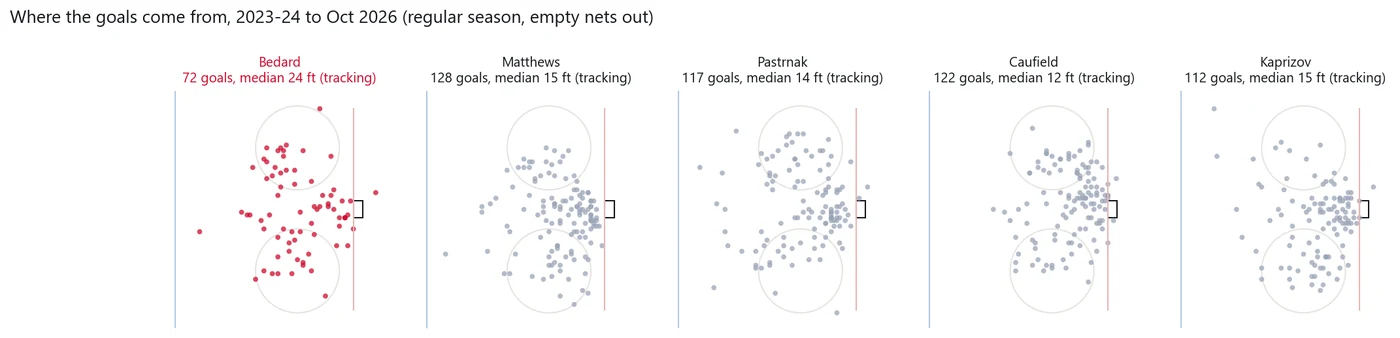
NHL tracking shows Connor Bedard scores on the move and from range more than Matthews, Pastrnak, Caufield or Kaprizov, and his snap shot beats expected more than any of theirs. Close to the net, he is still an average finisher.
Figures computed 2026-10-31, against the models as they stood that day. We change them — see the methodology page for where they are now.
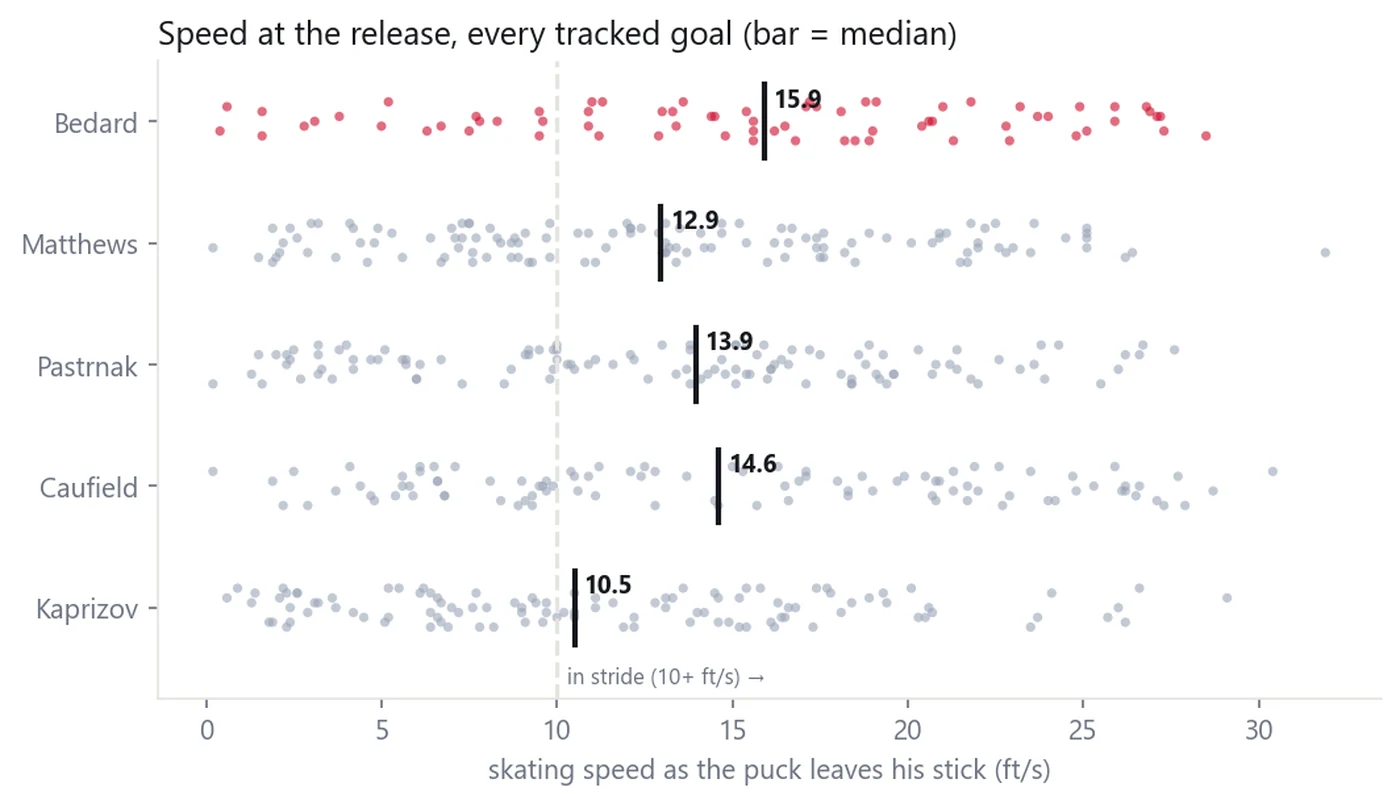
Connor Bedard shoots a lot in motion. Read at the moment the puck leaves his stick, his median goal comes from 24 feet out with him skating about 16 feet per second, farther and faster than Auston Matthews, David Pastrnak, Cole Caufield or Kirill Kaprizov. Three of every four of his goals come in stride.
His shot is what this piece is about: where it comes from, the snap shot behind it, and what it looks like frame by frame. Despite his reputation coming into the league, we're going to examine and show why he hasn't quite established himself as a proven sniper yet.
We picked those four players because they score in different ways. For every unblocked shot each has taken since Bedard arrived in 2023-24, we have where it came from, what kind of shot it was and how likely our model thought it was to go in. For their goals we also have the NHL's puck-and-player tracking, which shows where the puck was and how fast the shooter was skating at the moment it left his stick.
TL;DR
- He scores in stride, from range. His median goal comes from 24 feet out with Bedard skating 15.9 feet per second, the farthest out and fastest of the five. Three in four come while he's moving, and he does more of the work himself: 1.6 seconds from the pass to his release, also the longest of the five.
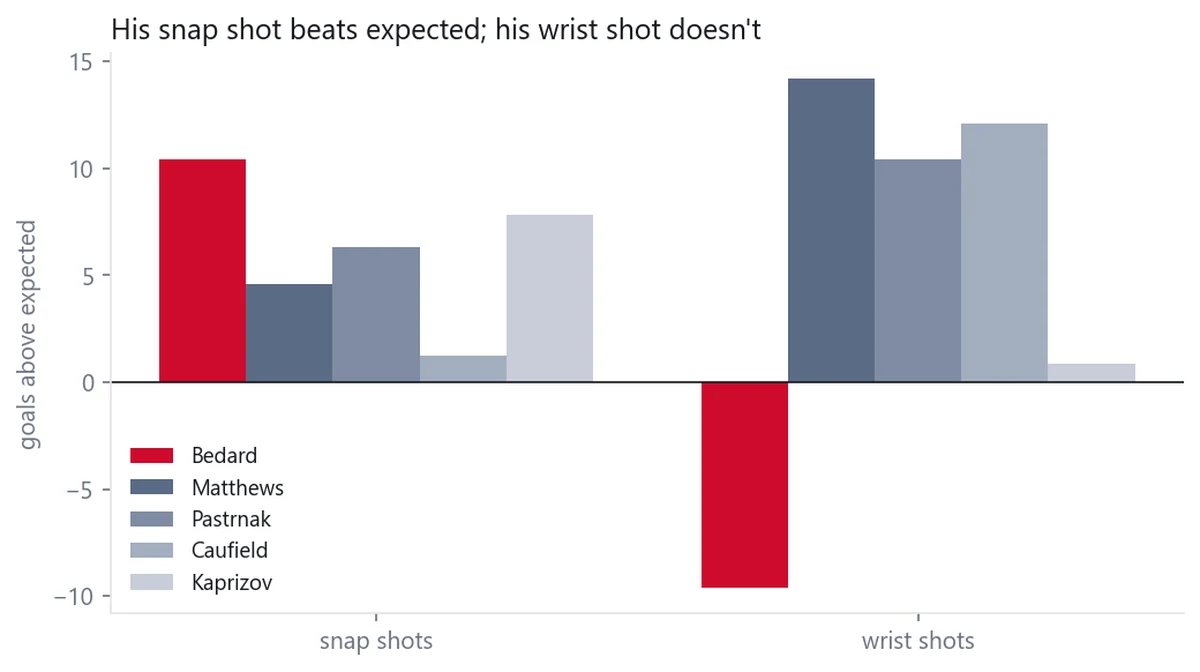
- The snap shot is the weapon. 29 goals on snap shots worth 18.6 expected: +10.4, the most of the five. His wrist shot, used three times as often, is 9.6 below expected.
- It isn't raw power. His hardest shot last season was 90.7 mph on NHL EDGE, a hard shot but not Pastrnak's. The release is the difference.
- You can see the stick load. In slow motion on his overtime winner against Winnipeg, the shaft visibly bends before the release.
- Not a proven sniper yet. Since 2023-24 he's scored about what the model expects (+0.1); the others are +15 to +21. Almost all of the gap is inside 30 feet, where he shoots less and finishes like an average shooter.
- Measured on his goals for the in-stride numbers, and on every unblocked shot for the rest.
In stride, from range
Start with where the goals come from. Read at the moment the puck leaves his stick, Bedard's median goal is 24 feet from the net. Matthews's is 15.3, Kaprizov's 15.2, Pastrnak's 14.3 and Caufield's 12.4. The others do most of their damage around the crease and the inner slot; Bedard's goals are spread out to the tops of the circles.
And he's moving when he shoots. His median skating speed at the release is 15.9 feet per second (about 11 mph), the fastest of the five: Caufield 14.6, Pastrnak 13.9, Matthews 12.9, Kaprizov 10.5. 74% of his goals come while he's skating at 10 feet per second or more, against 53% to 66% for the others. He doesn't need to stop, set his feet and load up. He shoots out of his stride.
He also does more of the work on his own goals. About seven in ten start from a teammate's pass, the same as for the others, but the median gap from that pass to his release is 1.6 seconds, the longest of the five (Caufield 1.4, Pastrnak 1.1, Kaprizov 0.9, Matthews 0.8). Only about a third of his goals are quick catch-and-release finishes inside a second, against more than half for Matthews and Kaprizov, and he carries the puck farther before shooting than any of them, a median of 13 feet.
One thing we expected didn't show up. A shooter who changes the angle with a toe drag just before releasing moves the puck sideways across the shot line. Bedard's sideways puck travel in the last half-second is the smallest of the five (a median 3.4 feet; Matthews 7.1). Whatever beats goalies from range, it isn't a late drag.
The snap shot
By volume, Bedard is a wrist-shot shooter: 60% of his unblocked shots are wrist shots, the most of the five, and they go in 5.2% of the time, a little under the league's 5.9%. Snap shots are 21% of his shots and go in 15% of the time, against 8.5% for the league.
Against our expected-goals model the split is starker. On snap shots he has scored 29 goals on 18.6 expected, 10.4 above, the most of the five (Kaprizov is next at +7.8). On wrist shots he's 9.6 below, where the others range from even to +14. And the snap shot is growing: 47 of them in his rookie season, 61 the next, 86 last season, with 7, 8 and then 13 goals.
It isn't raw power. NHL EDGE has his hardest shot last season at 90.7 mph, the 87th percentile league-wide, so it's a hard shot; the season before it was 83.1. Pastrnak's were 92.8 and 98.0. What makes the snap shot work is the release: quick, in stride, from a spot the goalie has to respect from well outside the slot.
There's a scene in Moneyball where Billy Beane listens to a room of scouts praise a prospect's swing, then asks the only question that matters: “If he's a good hitter, why doesn't he hit good?” Bedard's release gets the same kind of praise, but as a shooter overall he has scored about what the model expects. First, let's look at what the release looks like; then the question Beane would ask.
What it looks like
The overtime winner against Winnipeg in December 2023 is the shot in its purest form. Three-on-three, Bedard carries the puck for five seconds, and from 43 feet, skating 27 feet per second as the puck leaves his stick, he snaps it past Connor Hellebuyck.
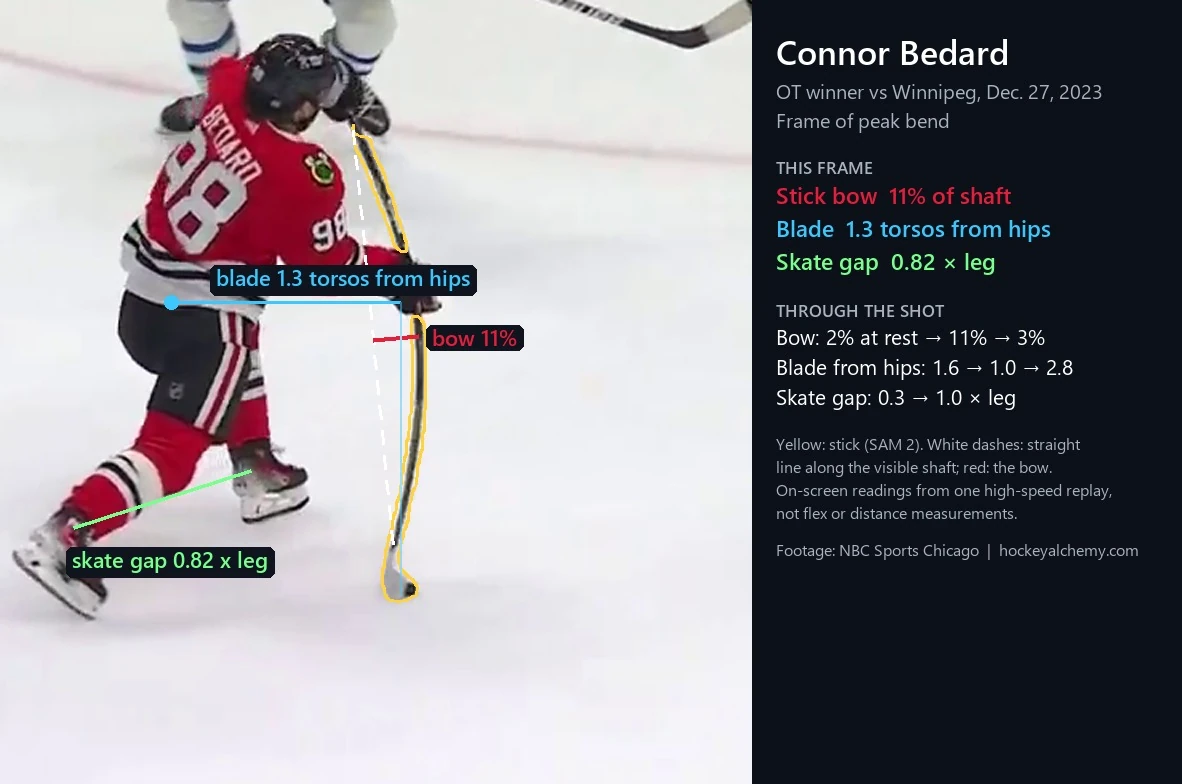
The slow-motion replay shows how. The blade stays on the puck out to his side while his bottom hand presses down and his top hand pulls in, and the shaft bends. A few frames later the puck is gone and the stick is straight again. He never stops skating to do it.
The rush version looks like this. At Vegas in December 2025 he takes the puck through the neutral zone and scores from 31 feet, again at about 27 feet per second at the release.
Tracking the stick itself took two tries. Our own stick detector works while he carries the puck out in front of him and fails at the moment that matters: at the release it locks onto his legs, a defender's stick or nothing at all, and it looks for straight lines, so it can't draw a bent shaft. A click-and-follow segmentation model, Meta's SAM 2, did better: you mark the stick once and it follows it through the clip. On the Winnipeg replay it held the stick through the release, which we checked frame by frame, so here it is. On another replay it lost the blade when sticks crossed, so we didn't use that one.
Measuring that outline gives a rough picture of the load. Even before he loads it, the shaft reads about 2% bent on screen: that's the floor of the measurement (the outline's edges, the camera angle and the joint where the shaft meets the blade), not real bend. Through the shot it bows to about 11% of its length at the deepest point, roughly nine points above that floor, then straightens back to about 3% through the follow-through.
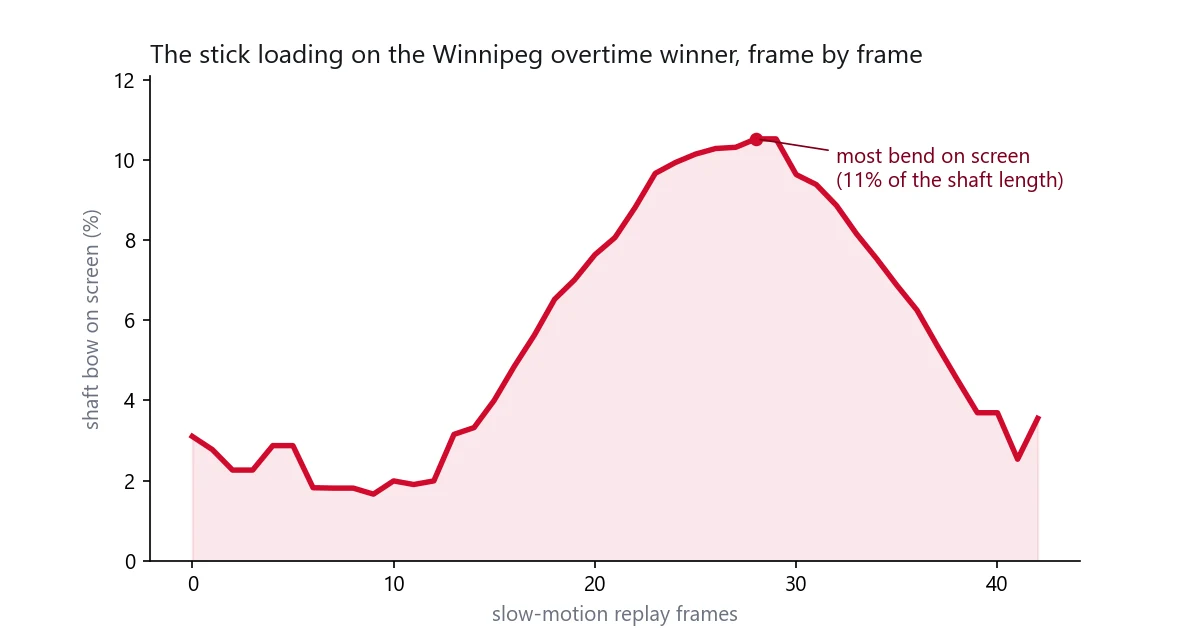
Read frame by frame, the order is clear. The bend builds while the shaft is still close to upright, peaks, and only then does the stick tip forward as his hands drive through, so the shaft unloads into the puck. The blade moves the same way: he draws the puck in toward his body as the shaft starts to load, then drives it back out through the release. At the same time his stride keeps lengthening: the gap between his skates, measured against his leg length, roughly triples from the start of the clip to the follow-through. He steps into the shot rather than planting for it, which is what the tracking's 27 feet per second looks like on video.
Put the pieces together and you get why the shot looks effortless. The puck leaves his stick mid-stride, with no pause to set his feet, from farther out than the others score from, and with almost no sideways movement in the last half-second. There's no wind-up for a goalie to read and no late move to follow, just a shot that's already on its way. That's our reading of the numbers, not something we measured on the goalie.
The people who cut the highlights seem to see it too. In the NHL's own titles and descriptions for these goals, admiring words like "beautiful", "beauty" and "wicked" show up on 14% of Bedard's, about twice the rate for the other four (6% to 8%). Add shooting verbs like "rips", "snipes" and "wires", and 40% of his goals get one or the other, against 16% to 35% for the rest. It's a playful measure, and the editors know who the star is, but it lines up with what the tracking says.
What the video measured
- Stick bow: reads about 2% on screen even before he loads it (the floor of an on-screen measurement, not real bend), peaking near 11% and back to about 3% through the follow-through.
- Order: the bend builds with the shaft close to upright; the stick tips forward only after the peak.
- Puck path: drawn in toward his body during the load (from about 1.6 to 1.0 torso lengths from his hips), then driven out to about 2.8.
- Stride: the gap between his skates, against his leg length, grows from about 0.3 to 1.0.
One high-speed replay, the Winnipeg overtime winner, read on screen with SAM 2 and our pose model. Camera angle and rolling shutter affect all of these, so read them as a picture of this shot, not league measurements.
Not a proven sniper yet
Despite the visual impressiveness of his shot, it hasn't quite added up to results. Since 2023-24 Bedard has scored 0.1 goals more than expected: as a finisher, right at average. Pastrnak is +15.1, Matthews +15.6, Caufield +15.9 and Kaprizov +20.8. Season by season he's been −1.7, +1.4 and −0.6, and +1.0 so far this season.
Almost all of the gap between him and the others is inside 30 feet. That's where snipers make their living, and Bedard shoots from there less than most: 45% of his shots come from inside 30 feet. Only Pastrnak (41%) is lower; the others are at 58% to 64%. Inside that range the others are 13 to 20 goals above expected. Bedard is −0.5: he finishes close shots at about the rate the model expects.
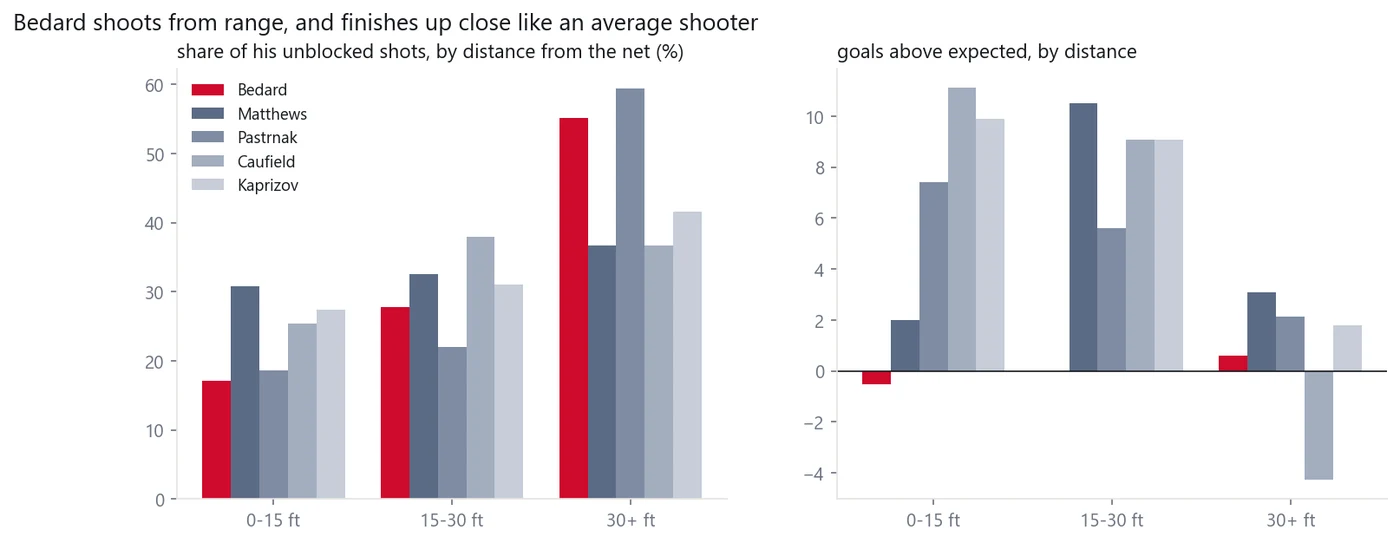
From range he scores often: 5.1% of his shots from 30 feet and beyond go in, against a league rate of 3.1%, and only Matthews (5.6%) is better among the five. But the model saw that coming: it rates his long shots at about 5% too, well above a typical long shot, and against expected he's roughly even from there (+0.6). The release shows up in the snap shot. What he hasn't done yet is the other half of sniping: getting to the dangerous ice more often and burying what he gets there.
The two halves may be connected. The habit that makes his shot so dangerous, shooting in stride from range, also keeps him away from the ice where snipers pile up their goals. That's a hypothesis rather than something this data proves, but it's the thread worth pulling: if he keeps the release and adds more trips to the slot, both halves of this piece point the same way.
What to watch
Two numbers will say whether the second half of this piece ages badly. The share of his shots from inside 30 feet (45% so far), and his goals above expected from there (−0.5 since 2023-24). The snap shot suggests the touch is there. If he starts taking it closer to the net, the sniper label could follow. And time is on his side: finishing tends to peak in a player's early-to-mid 20s, so at 21 the close-range half of this piece is the part most likely to change.
What this can't tell us (yet)
This is a first look, and the data has edges worth naming. Each one is also a next step.
Goals only. The tracking covers his goals, so it shows how he scores, not whether his in-stride shots go in more often than his set ones. Tracking on every shot, misses and saves included, would answer that.
Four comparisons, not the league. He leads this group on distance and skating speed at the release; where that ranks across the whole NHL is the next thing to measure.
The release, inferred. The case for his release comes from his snap-shot results and his EDGE shot speed. Release time, measured from high-speed replays, would show it directly.
Where it goes in. The play-by-play doesn't record where in the net a goal goes, and the tracking doesn't record the puck's height, so the top-corner look of so many of his goals isn't measured here.
Help. Whether he needs better linemates is its own question. This measures what he does with the puck, not who he plays with; that comparison is next.
What expected goals can't see. Our model doesn't know about release speed, screens or deception, so some of what reads as finishing may be things it misses, in either direction.
One replay of the stick. The bend and stride readings come from a single high-speed replay. We looked through 120 highlight clips of all five shooters for more footage like it and found none clean enough, so a stick-by-stick comparison waits on better video.
Where the data comes from
Shots. Every unblocked regular-season shot from the NHL play-by-play, 2023-24 through October 2026, empty-net shots and shootout attempts left out: location, shot type and result. Expected goals are our own model's.
Tracking, goals only. The NHL's puck-and-player tracking, the data behind the top-down goal replays on NHL.com, gives every player's and the puck's position ten times a second for the play before each goal. It exists for goals, not every shot, so the distance-at-release and speed-at-release numbers describe how these players' goals happened, not all of their shots. The release is the last moment the puck is on the scorer's stick before it reaches the net. Regular season only, empty-net and shootout goals left out, and goals where the tracking doesn't show the release are left out too (Bedard 2 of 72). A pass is the last teammate to control the puck, within seven feet of it for at least 0.3 seconds, before it reaches the scorer.
Shot speed. NHL EDGE's own figures, regular season.
Clip titles. The NHL's official title and description for each goal's highlight clip, 549 goals across the five. Admiring words are beautiful, beauty, wicked, slick, nifty and the like; shooting verbs are rips, snipes, wires, fires, roofs and the like.
Video. The clips and the annotated still are broadcast replays (NBC Sports Chicago, ESPN+), posted as illustration. The skeletons come from our pose model and the stick outline from SAM 2. The only readings taken from video are the ones in the "What the video measured" box, all from that one Winnipeg replay; every other number comes from the shot and tracking data.
Data: NHL play-by-play and puck-and-player tracking (10 per second); NHL EDGE. Regular season, 2023-24 through October 2026, empty nets and shootouts out. Tracked goals with a located release: Bedard 70, Matthews 122, Pastrnak 114, Kaprizov 108, Caufield 97. Unblocked shots: Bedard 936, Matthews 1,297, Pastrnak 1,402, Caufield 1,229, Kaprizov 1,091.
Frequently Asked Questions
How does Connor Bedard score?
On the move and from range. On his 70 regular-season goals with tracking that shows the release (empty-net and shootout goals left out), the median one came from 24 feet out with Bedard skating 15.9 feet per second, the longest and fastest of the five shooters we compared, and three in four came while he was moving at 10 feet per second or more.
Is Connor Bedard's snap shot good?
It's his best weapon. From 2023-24 through October 2026 he scored 29 goals on snap shots that our model expected to produce 18.6, 10.4 above expected and the most of the five shooters we compared. His wrist shot, which he uses three times as often, is 9.6 goals below expected.
Is Connor Bedard a sniper?
Not yet proven. Since 2023-24 he has scored about as many goals as expected (0.1 above), against 15 to 21 above for Matthews, Pastrnak, Caufield and Kaprizov, and almost all of the gap is inside 30 feet: fewer than half his shots come from there, and he finishes them at about the rate the model expects.
More from the Notebook
Inside the NHL EDGE Goal Visualizer: How We Scrape, Clean and Use Tracking Data
The NHL publishes about fourteen seconds of player tracking for every goal, ten frames a second. We hold 26,237 of them. How we fetch it, the four bugs we shipped handling it - none of which ever errored - what it is good for, and the one thing it can never do.
Who Can Afford Nikita Kucherov? The Trade Request from Three Sides
Nikita Kucherov wants out of Tampa Bay at 33. Our numbers say he isn't declining, elite forwards age slowly, and the right fit is a team that can put a defensive winger next to him.
How We Rebuilt Our Expected Goals Model
Measured on shots it had never seen, our old expected goals model was not as good as we thought. We found where the data and the model were wrong and rebuilt both. Here is what changed, why, and how much better the new model is.